
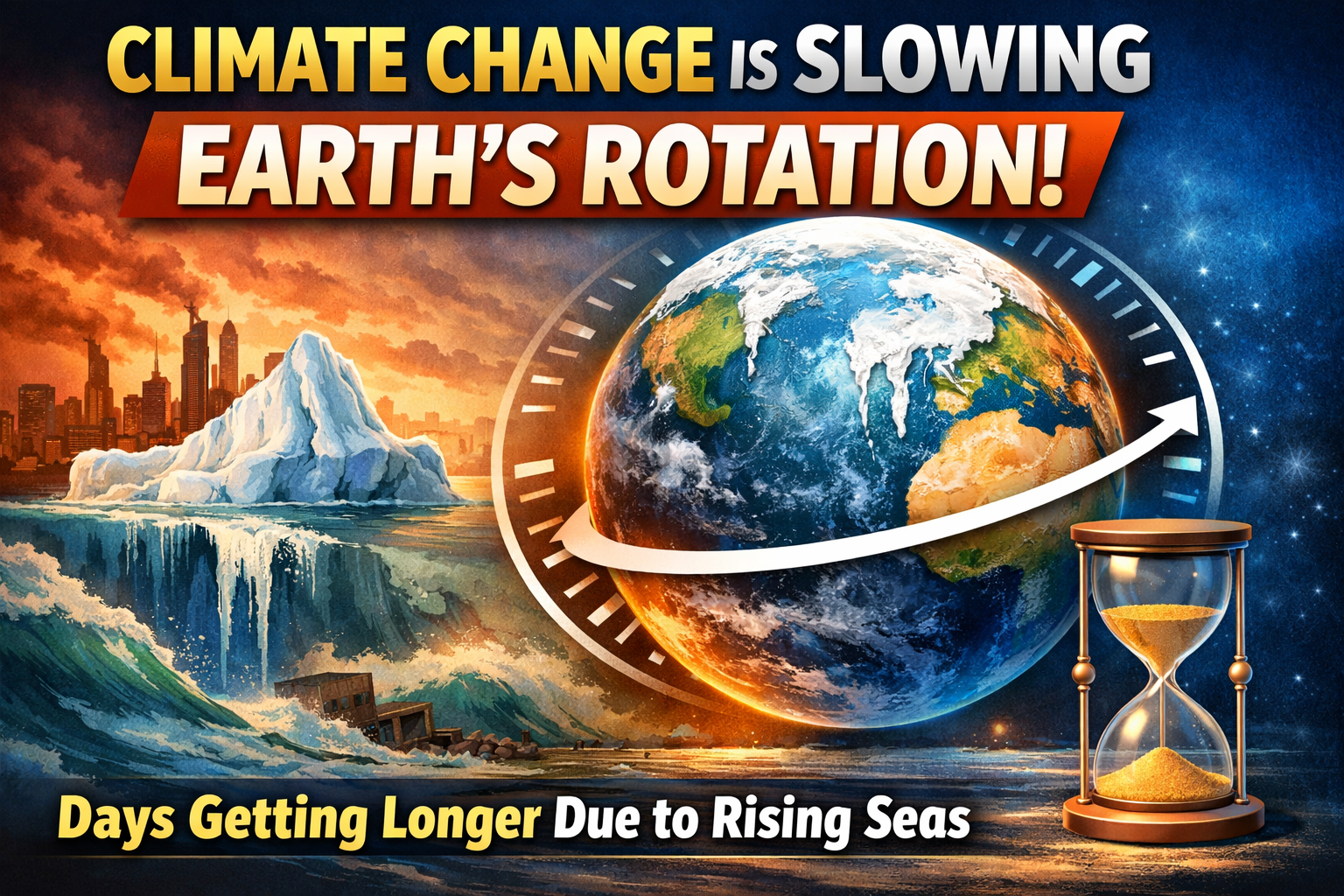
For millions of years, the Earth has been spinning at a steady pace, giving us the familiar 24-hour day. But scientists now say that something unusual is happening. Human-driven climate change is not only changing the weather and raising sea levels — it is also slowly changing the speed at which the planet rotates.
According to a new scientific study, rising sea levels are increasing the length of a day by about 1.33 milliseconds per century. This may sound extremely small, but for scientists who study the Earth’s rotation, it is a very significant change. In fact, researchers say this rate of change has not been seen for 3.6 million years.

How Climate Change Is Affecting Earth’s Spin
To understand this, imagine a figure skater spinning on ice. When the skater pulls their arms close to the body, they spin faster. When they stretch their arms outward, the spin slows down. The same idea applies to Earth.
As global warming melts ice in the polar regions, huge amounts of water move from the ice sheets into the oceans. This water spreads across the planet, which changes how the Earth’s mass is distributed. When the mass spreads out, the planet spins a little more slowly — and the day becomes slightly longer.
The Moon Also Plays a Role
The slowing of Earth’s rotation is not entirely new. For billions of years, the Moon’s gravity has been gradually slowing the Earth. The Moon creates a small bulge in the oceans, and this constant gravitational pull increases the length of the day by about 2.4 milliseconds per century.
However, another process called glacial isostatic adjustment works in the opposite direction. After the last Ice Age, the Earth’s crust has slowly been rising where heavy ice once existed. This process slightly speeds up the Earth’s rotation and reduces the day length by about 0.8 milliseconds per century.
When these natural factors are combined, the Earth’s day length normally increases very slowly. But now, scientists believe that modern climate change is adding a new and unusually fast influence.
What Makes This Discovery So Important
Researchers from ETH Zurich studied tiny ocean fossils called foraminifera to understand how sea levels and Earth’s rotation changed millions of years ago. By studying oxygen levels in these fossils, they were able to estimate how long a day used to be in ancient times.
Their findings show that the current increase in day length — 1.33 milliseconds per century — is one of the fastest changes in millions of years. If global temperatures continue to rise, the length of a day could increase even faster in the future.
Will We Notice This Change?
For ordinary people, the change is too small to notice. A few milliseconds added to a day will not affect our daily life. However, it can affect:
- Satellite systems
- Spacecraft navigation
- Scientific instruments
- High-precision timekeeping systems
Even a tiny change in Earth’s rotation matters in advanced technology.
What This Means for the Future
This discovery shows how powerful human activity has become. Climate change is no longer only about rising temperatures or melting glaciers. It is now affecting the physical behavior of the entire planet.
The melting of polar ice, rising oceans, and shifting climate patterns are all connected. Scientists believe that if global warming continues, Earth’s rotation may keep slowing gradually over the coming decades.
Conclusion
The idea that human activity could influence the rotation of the Earth may sound unbelievable, but science is proving that it is possible. The planet is extremely sensitive to changes in temperature and sea levels. Even small changes in climate can lead to measurable changes in how the Earth moves.
This study is not a warning of immediate danger, but it is a powerful reminder of how deeply human-driven climate change is affecting our world — not only the environment, but the planet itself.