
Introduction
Climate change is one of the most pressing global challenges of the 21st century. Scientists around the world working with the Intergovernmental Panel on Climate Change (IPCC) have been studying how human activities are influencing the Earth’s climate.
According to scientific reports, the Earth’s surface temperature increased by about 1.1°C between 1900 and 2020. This warming is mainly caused by burning fossil fuels, which release carbon dioxide and other greenhouse gases into the atmosphere.
Although 1°C may seem small, it is actually the fastest warming recorded in over 2,000 years, and even this small change has significant effects on weather patterns, ecosystems, and ocean systems.
Future Temperature Projections
Climate models suggest that global temperatures will continue to rise throughout the 21st century.
Scientists estimate that:
- Global temperatures could increase 1–1.5°C by 2050 if emissions are controlled.
- If greenhouse gas emissions continue to grow, temperatures could rise 4–5°C by the end of the century.
The potential temperature trend can be simplified as a gradual increase over time:
Where:
- T(t) = temperature at time t
- T₀ = current global temperature
- r = rate of temperature increase per year
This simple representation shows how even a small yearly increase can lead to major climate changes over decades.
Uneven Global Warming
Climate change will not affect every region equally.
Scientific models predict:
- Land areas will warm faster than oceans
- Polar regions will experience the largest temperature increases
- Tropical and mid-latitude regions will experience moderate warming
The Arctic, for example, is already warming twice as fast as the global average.
Changing Precipitation Patterns
As temperatures rise, the global water cycle accelerates.
Warmer air holds more water vapor, which leads to:
- More intense rainfall events
- Increased flooding in some regions
- Longer droughts in others
Scientists estimate that global precipitation may increase by about 7% for every 1°C rise in temperature.
With a 2°C temperature increase, extreme rainfall events could become 1.7 times more frequent and 14% more intense.
Melting Ice and Glaciers
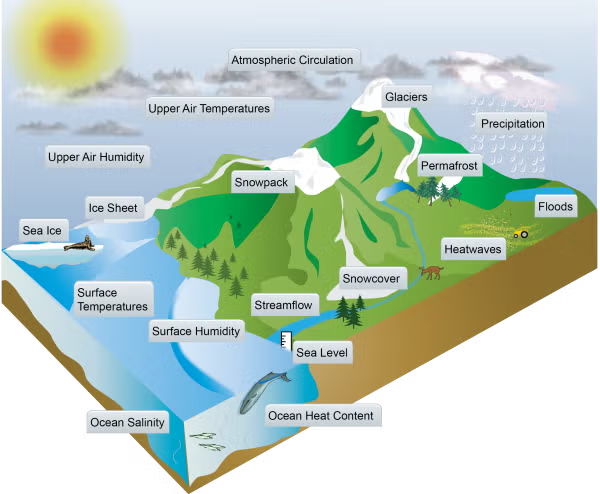
One of the clearest signs of climate change is the rapid melting of glaciers and ice sheets.
Observed changes include:
- Shrinking mountain glaciers worldwide
- Loss of Arctic sea ice
- Faster melting of Greenland’s ice sheet
- Thawing Arctic permafrost
Scientists believe that Arctic summers could become nearly ice-free by the end of the century.
Rising Sea Levels
Sea levels are rising because of two major processes:
- Melting glaciers and ice sheets add water to the oceans
- Warmer water expands and occupies more space
Since 1880, global sea levels have risen 10–20 cm.
Future projections suggest:
- 0.25–0.30 meters rise by 2050
- Up to 1.1 meters by 2100 without major emission reductions
This rise could threaten coastal cities, wetlands, and global trade infrastructure.
Ocean Acidification
The oceans absorb a large portion of the carbon dioxide produced by human activities. While this helps slow atmospheric warming, it creates another problem.
When CO₂ dissolves in seawater, it forms carbonic acid, making the ocean more acidic.
Scientists estimate that ocean pH has already dropped by 0.1 units since pre-industrial times, and it may drop another 0.14–0.35 by 2100.
This threatens marine ecosystems, particularly coral reefs and shell-forming organisms.
Changes in Severe Weather
Climate scientists predict that warming oceans will influence storms and extreme weather events.
Possible changes include:
- Stronger hurricanes and typhoons
- More frequent heat waves
- Increased droughts
- Greater wildfire risks
While the total number of storms may not increase significantly, the most powerful storms are expected to become more common.
Risks to Marine and Land Ecosystems
Climate change will reshape ecosystems across the planet.
Marine impacts may include:
- Coral reef bleaching
- Shifting fish populations
- Loss of marine biodiversity
On land, rising temperatures may:
- Shift plant and animal habitats
- Increase extinction risk
- Expand the range of disease-carrying insects like mosquitoes
If global warming reaches 2°C, scientists estimate that:
- 18% of insects
- 16% of plants
- 8% of vertebrate animals
could lose over half of their natural habitat.
Climate Tipping Points
Some climate changes may occur suddenly once certain thresholds are crossed. These are known as climate tipping points.
Examples include:
- Collapse of major ice sheets in Greenland and Antarctica
- Disruption of global ocean circulation
- Rapid methane release from Arctic permafrost
- Saturation of oceans’ ability to absorb carbon dioxide
Although these events are considered unlikely in the immediate future, their consequences could be severe and irreversible.
Conclusion
Climate change is already reshaping the planet, and its effects are expected to intensify in the coming decades. Rising temperatures, melting ice, stronger storms, and shifting ecosystems are all part of a complex global transformation.
However, the future is not predetermined. The amount of climate change the world experiences will depend on decisions made today about energy use, emissions, and environmental protection.
With strong global action and sustainable innovations, humanity still has the opportunity to limit warming and create a more stable climate for future generations.